


In the heart of Swansea, a coastal city of 250,000 in South Wales, UK, a former department store is taking on a new life. Rooftop gardens, green terraces, and a multi-level glasshouse are set to rise above energy-efficient apartments, offering residents the chance to grow their own food, tend community gardens, or surround themselves with greenery.
This isn’t just an urban makeover; it’s biophilic design in action, bringing nature into the very fabric of city living. For European cities grappling with rising heat, floods, and widening inequality, Swansea offers a UK-first example of how a building under development, with greenery, community spaces, and sustainable design, could improve health, strengthen communities, and boost climate resilience all at once.
Researchers from Swansea University, Andrew H. Kemp, Lowri Wilkie, and Kirsti Bohata, tell us more about the Swansea Biophilic Living Project.
Good health depends on more than healthcare alone. Across Europe, it increasingly hinges on the places where people live, work, learn, and play, and right now, those environments are under pressure. Rising urban heat, floods, air pollution, and social inequalities are exposing the fragility of city life, making the design of urban spaces more urgent than ever.
The built environment shapes health, equity, and resilience, influencing risks for chronic disease, mental wellbeing, and social connections, yet for many urban residents, cities fall short.
Talking with Professor Sir Michael Marmot, a leading authority on public health, celebrated for his groundbreaking work on social determinants of health and reducing health inequalities, underlines the stakes. He reminds us that a life worth living is more than food, shelter, and sanitation: it must include opportunities for social fulfilment and enrichment through nature. Equitable action on sustainability, he adds, is a crucial pathway to health equity.
In Swansea, this principle is being put into practice. The city is embedding access to nature into social housing, so that everyone, not just the privileged few, can benefit.
In 2025, Wales committed to becoming the world’s first Marmot Nation, embedding social determinants of health — broadly defined by the World Health Organization (WHO) as the conditions in which people are born, grow, live, work, and age, and people’s access to power, money and resources — into national and local policy. Building on the Well-being of Future Generations Act, which requires public bodies to consider long-term social, economic, environmental, and cultural wellbeing, this small Welsh city is testing how these policies can shape healthier, fairer urban living.
Nature as medicine
Biophilic design, the deliberate integration of natural elements into buildings and public spaces, has measurable effects on mental and physical health.
Structured nature-based interventions, sometimes called ecotherapy, improve outcomes for depression and anxiety while promoting community engagement and pro-environmental behaviours (Isham et al., 2025). Access to green and blue spaces correlates with lower all-cause mortality, in part due to cleaner air, increased physical activity, and stronger social connections (Rojas-Rueda et al., 2019; Guidolin et al., 2024). Contact with nature reduces stress and supports recovery (Ulrich, 1984). Regular access to green space reduces depression and anxiety, especially in deprived areas (Geary et al., 2023).
But research consistently shows that these benefits are not evenly shared. The poorest urban communities often face the greatest exposure to heat, flooding, and pollution while having the least access to safe, high-quality green space, a growing issue known as “green space justice.” (Dong et al., 2024; Gao et al., 2023; Rigolon et al., 2021; Geary et al., 2023; Janeka et al., 2025).
Collectively, this evidence underscores the potential of nature-based approaches to benefit both human and planetary health. Swansea’s project explicitly seeks to ensure these benefits are equitably distributed, addressing a pressing European challenge: reducing health inequalities in urban environments.
Nature-based solutions and equity
Nature-based solutions (NBS), defined by the European Commission as cost-effective interventions delivering environmental, social, and economic benefits while building resilience, provide a useful framework for projects like Swansea’s. According to the WHO, NBS can improve air quality, encourage activity, and boost mental wellbeing, as Wales’ Local Places for Nature programme demonstrates, bringing people of all ages together.
Yet these benefits aren’t automatic. Without deliberate attention to equity, interventions risk reinforcing rather than reducing existing disparities. This initiative has the potential to illustrate that social housing, community spaces, and greenery can be combined to deliver fairer, healthier cities. Embedding social equity into design ensures that adaptation to climate change also strengthens social justice, one of the guiding principles of the Marmot framework.
“Access to a green space like the Vetch, the former football ground in Swansea, showed great foresight from our local government,” says a Swansea resident. “It has become an invaluable source of greenery for older people like me, giving us a place to meet, socialise, and stay active.”
On projects like the new development, he adds: “Bringing communal gardens and natural spaces into housing shows how having nature close to people’s homes can make a real difference, particularly in Wales, where, even though we’re surrounded by nature, mobility barriers mean it isn’t always easy to reach.”
Scotland’s Place Standard tool shows plainly that the design of our streets, parks, and neighbourhoods, from green space and housing to transport and safety, shapes health, wellbeing, and equity, showing where communities thrive and where they struggle, and illustrating the power of biophilic principles in everyday urban life.
A biophilic retrofit for urban wellbeing
The REPAIR: Retrofitting for the Future initiative, funded by the Arts and Humanities Research Council (part of UK Research and Innovation fund), is assessing the impact of a £30 million (approx. €34.0 million) transformation of a disused city-centre retail building into the UK’s first large-scale biophilic retrofit.
This work forms part of a £3 million research programme exploring how biophilic design can advance health equity and other benefits through urban regeneration, linking academic insight with lived community experience.
The design includes nine floors of energy-efficient apartments, managed by the social housing association Pobl. These flats will rise above green terraces, communal gardens, and a multi-level glasshouse where fish and plants are grown together in a closed-loop system — a form of urban farming known as aquaponic. Residents will have the opportunity to take part in horticultural activities or simply enjoy daily contact with nature. This makes the building both sustainable and climate-resilient, offering residents new ways to connect with food, nature, and community.
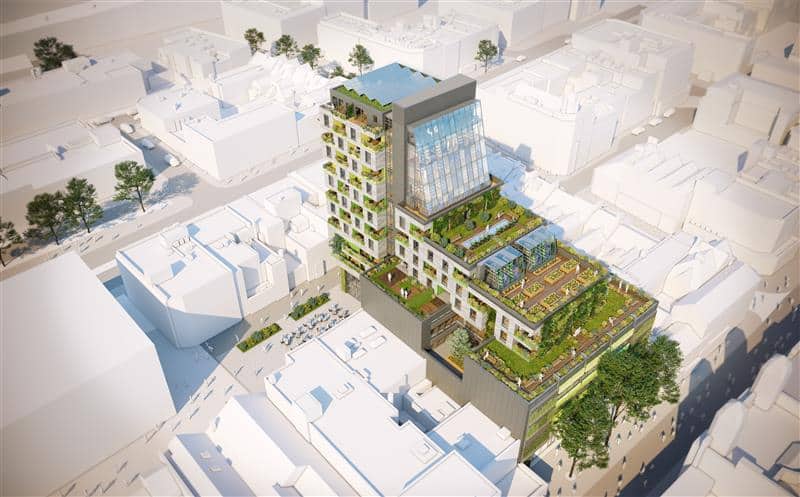
Image ©Hacer Developments Ltd/Biophilic Centre of Excellence
As Pobl notes online:
Recycled grey water — treated from sinks, showers, and washing machines — is planned to irrigate the plants and green walls on every level, while low-carbon heating will be provided by a solar roof.
Beyond immediate environmental benefits, such retrofits are expected to have the potential to strengthen social connections, improve residents’ mental and physical wellbeing, and deliver long-term social and economic gains, including reduced healthcare costs, fewer days lost to illness and work, lower poverty levels through affordable housing, and avoidance of energy poverty.
By integrating living, work, and community spaces, a project such as this shows that access to healthy urban environments can be for everyone, and not just for those higher up the economic ladder. The initiative offers a model for other European cities seeking to align housing, climate adaptation, and health equity objectives, showing how investments in social infrastructure can deliver multiple societal benefits.
Translating policy into action on the ground
Embedded within Wales’ Mental Health and Wellbeing Strategy 2025–2035 and operationalising Marmot principles, the initiative supports a decent standard of living for all, creates healthy and sustainable communities, and advances environmental sustainability alongside health equity. This is a rare real-world test case of how policy commitments can translate into tangible urban outcomes. European policymakers can use this example to inform similar strategies, particularly where health inequalities intersect with climate vulnerabilities.
Joined-up thinking across sectors
What makes this project distinctive is not just its biophilic retrofit of urban space, but its collaborative endeavour. Rather than a traditional “top-down” model, it brings together academics, policymakers, housing developers, local government, schools, and citizens to co-produce pathways to wellbeing.
Researchers from disciplines as diverse as English literature, anthropology, and law sit alongside ecology, psychology, and public health. They work with societal partners who bring expertise in planning, retrofitting, and community regeneration. This enables the project to engage not only with technical and governance tools but also with cultural narratives — how storytelling, community arts, and speculative futures can shape how people imagine healthier cities.
By treating the research process itself as part of the transformation, the team uses reflection and dialogue to shape how decisions are made, strengthening the collective leadership and empathy needed for sustainable wellbeing.
The initiative also serves as a testbed for collective leadership, guided by the Thrive Team, convening principles, collective coaching, and the Inner Development Goals (IDGs), which focus on inner capacities such as openness, empathy, and shared purpose, qualities essential for real-world collaboration and change. By doing this and using reflection and dialogue to guide decisions and leadership, the project strengthens the skills and relationships needed to build sustainable wellbeing (Schüz, 2025; Shrivastava et al., 2024; Janeka et al., 2025).
Europe’s path forward
With Europeans spending around 90% of their lives indoors, the design of our buildings is no longer just an aesthetic choice, it’s a public health priority. The Swansea Biophilic Living project is reimagining healthy living environments to promote equity, resilience, and hope. By weaving nature into the urban fabric, Wales is testing how to reduce chronic disease, boost mental wellbeing, and build stronger communities.
The project brings ambitious strategies, such as Marmot Nation and the Well-being of Future Generations Act, to life in everyday practice. Across Europe, where cities face rising heat, floods, and widening inequality, it shows that healthier, fairer futures are possible when people and nature thrive together.
In that spirit, we welcome opportunities to expand European partnerships, to build collaborative partnership initiatives that are rethinking social housing, biophilic wellbeing, and community-led adaptation. By sharing evidence and best practice, cities can create urban environments that genuinely support wellbeing, demonstrating how green, wellbeing-focussed spaces can become a standard for cities, not just in Wales, but across the continent.
Every page has a partner
This article draws on the collective work of REPAIR: Retrofitting for the Future: Nature-Based Solutions for Climate Adaptation project team, funded by the Arts and Humanities Research Council Mission Award (Grant Ref: APP65361 – OPP734). We gratefully acknowledge our co-principal investigators and societal partners, including colleagues from Natural Resources Wales, Pobl Group, Hacer Developments Ltd and the City and County of Swansea Council, whose collaboration continues to shape this project.
This article is written on behalf of the wider REPAIR collective, whose shared goal is to advance biophilic living using transdisciplinary approaches to health equity, holistic wellbeing and climate adaptation.
Find out more about this initiative by clicking this link.

Andrew H. Kemp
Andrew Kemp is Professor of Psychology at Swansea University, where his work explores how individuals, communities and places can flourish amid accelerating social, ecological and public health challenges. His research spans affective neuroscience, epidemiology, wellbeing science, existential positive psychology and climate psychology, with a focus on how multilevel interventions, from contemplative practices to biophilic and nature-based approaches, can support meaningful, connected and sustainable living. He is co-lead of a major AHRC Mission Award on nature-based climate adaptation and collaborates with interdisciplinary partners to integrate systems thinking, community engagement and participatory, mixed methods research.
Recent publications include “Green healing: Ecotherapy as a transformative model of health and social care” (Current Opinion in Psychology, 2025), “Improving Wellbeing Through Local Communities: A Mixed Methods Study on the Role of Relationship Building” (Journal of Happiness Studies, 2025), and “Improving student wellbeing: Evidence from a mixed effects design and comparison to normative data” (Teaching of Psychology, 2024).
Professor Kemp has published widely, contributing conceptual and applied insights that inform wellbeing policy, public health innovation and place-based adaptation strategies. His academic leadership has been recognised through a Doctor of Science degree from the University of Melbourne (2019) and awards from the British Psychological Society (2019) and the Association for Psychological Science (2017).

Lowri Wilkie
Dr Lowri Wilkie, PhD, is a psychologist whose work explores wellbeing as a connection to self, others, and the planet. Her research spans positive psychology, wellbeing science, behaviour change, environmental psychology, systems change and healthcare reform.
She has published widely in peer-reviewed journals and book chapters, contributing theoretical frameworks to inform how societies can prioritise wellbeing at individual, collective and systemic levels. Alongside her academic work, Lowri is a yoga and mindfulness teacher, delivering evidence-based programmes across healthcare and community settings.
Bringing contemplative science and wellbeing policy, she works to integrate inner awareness, compassion, community, purposeful action, and connection to nature into the design of public systems, strengthening their capacity to support equitable, sustainable, and meaningful living.

Kirsti Bohata
Kirsti Bohata is Professor of English at Swansea University where she is co-Director of the Faculty of Humanities and Social Sciences Climate Action Research Network (CARN) and the Centre for Research into the English Literature and Language of Wales (CREW). Her interdisciplinary work includes: Climate Lab (a collaboration between climate scientists and artists), funded by the Natural Environment Research Council (NERC); the transdisciplinary network, Narrating Rural Change, studying rural and agricultural change in the context of the climate and ecological crises (with funding from NERC and the Arts and Humanities Funding Council (AHRC); a literature-geography collaboration culminating in Literary Atlas (mapping novels from Wales). Her work in engages with postcolonial theory, queer theory and disability studies.
Recent publications include Queer Square Mile: Queer Short Stories from Wales (2022), co-edited with Mihangel Morgan and Huw Osborne, Disability in Industrial Britain: A Cultural and Literary History of Impairment in the Coal Industry, 1880–1948 (2020), co-authored with Alexandra Jones, Mike Mantin and Steven Thompson and funded by Wellcome Trust. Her first book was Postcolonialism Revisited: Writing Wales in English. She is series editor of the ‘Library of Wales’ classics and co-editor of the University of Wales Press series, ‘Writing Wales in English’.