

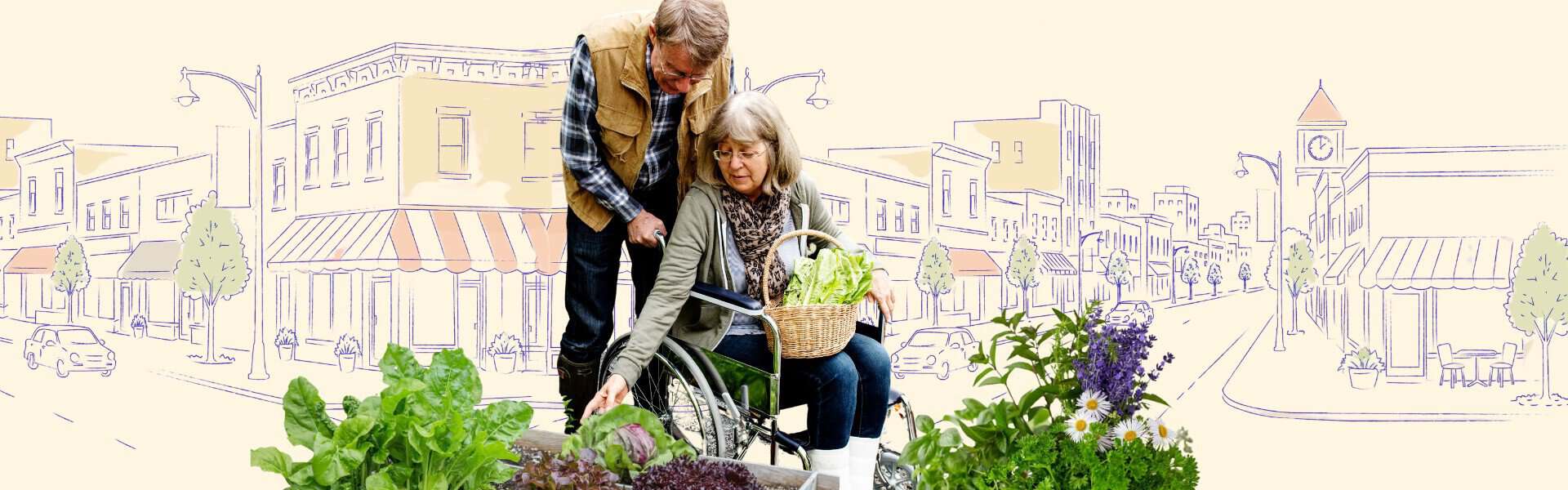
Where we live shapes how well we age. Over a decade ago in Austria, a handful of neighbourhood projects set out to strengthen relationships between neighbours and, through them, improve health and wellbeing. Today, they are shaping national funding priorities and a new platform for healthy ageing. This article shows how local lessons became a nationwide model based on the principle that healthy ageing is a shared task.
Words by Petra Plunger, Barbara Preiner, and Gerlinde Rohrauer-Näf from the Austrian National Public Health Institute (Gesundheit Österreich GmbH - GÖG).
Healthy ageing is shaped largely by the places where we live and interact with one another. Social participation, sustainable neighbourhoods, and projects that bridge generations all strengthen health, wellbeing and quality of life in old age. Austria has built its approach on that idea: back good local projects, scale them up step by step, and get different sectors working together.
Starting with the neighbourhood
The work began in 2012, when the Austrian Health Promotion Fund (FGÖ) launched Towards a Healthy Neighbourhood! (‘Auf gesunde Nachbarschaft!)’ The initiative sets out to strengthen social relationships within residential communities and, through them, health, wellbeing, and participation. Over several project phases, it has reached families, older people and intergenerational communities. Its current focus is on Caring Communities, which make caring for older people a shared task of the whole community. To make such communities happen, it takes a participatory and intergenerational approach.
The aim is to foster a culture in which care does not rest on professional health and social services alone, but is seen as a shared responsibility of citizens, voluntary organisations, neighbourhoods, local authorities, institutions and politicians.

Graphic 1: Action fields of the model ‘Community-based health promotion for healthy ageing – caring communities’. Source: Plunger et al. (2023)
From projects to a model
Experience from these projects fed into a model for ‘Local Health Promotion for Healthy Ageing – Caring Communities’ (available in German here). It sets out six areas of action: using data and evaluation to plan and manage; building participation and development processes; supporting neighbourhoods and voluntary work; creating hubs for networking and referral; making living environments, facilities and businesses health-promoting; and offering services for health promotion and health literacy.
A policy brief followed, written for local stakeholders with support from EuroHealthNet: ‘Local health promotion for healthy ageing in towns and cities’ (available in German Its message is that health promotion for healthy ageing works, and that its benefits reach beyond health services or older people themselves.
Taking healthy ageing to the national level
National funding is now following. Under the Federal Agency’s Preventive Funding Strategy, which supports quality-assured, supra-regional projects, the focus for 2024–2028 covers two groups: young people’s mental health and ‘(local) health promotion for older people aged 60 and over’. As part of the strategy implementation, a fall prevention pilot is already being rolled out across Austria by the Austrian Health Insurance Fund.
Building on the lessons of these projects, and as a further step in implementing the strategy, the Austrian Public Health Institute, commissioned by the Ministry of Health, has launched the Platform for Health and Quality of Life in Old Age. It brings quality-assured, evidence-based information together in one place for professionals in local authorities and towns, practitioners, decision-makers, teachers and researchers, helping them plan, implement and evaluate measures for healthy and positive ageing. Its motto: “Shaping the future, promoting health, rethinking ageing.”
One project, three tools
The ‘Platform for Health and Quality of Life in Old Age’ was launched at the end of September 2025 to provide evidence-based information on all aspects of healthy ageing. It offers regional health profiles with health data analysed at the level of healthcare regions. Users can also find the latest reports and studies on healthy ageing in Austria, links to international and national strategy papers, examples of good practice and tools, as well as training and further education opportunities.
A key component of the platform is a newly developed Good Practice Portal and Toolbox for Healthy Ageing. Currently being piloted and evaluated, the Portal and the Toolbox bring together knowledge from research and practice, presenting proven health promotion measures for healthy and positive ageing in a concise format (more information available in German here).
The measures featured in the Toolbox range widely. They include fall prevention and approaches to social participation and quality of life, such as ‘health buddies’, who are volunteer peers. There are also ‘dementia-friendly’ pharmacies and libraries. The toolbox adds tried-and-tested methods, including network analysis (with focus groups and participatory interviews) and professionally supported neighbourhood assistance. For anyone working on older people’s participation, guides, digital planning tools, and handbooks are available to download for free.

Graphic 2: Project health and quality of life in ageing. Source: GÖG
Putting information online is not enough, so the project also invests in communications, training and further education initiatives. The platform links to a free e-learning course (MOOC), ‘Healthy Ageing’, that anyone can join at any time. Its six lessons use expert interviews, podcasts, and quizzes to cover physical and mental health, nutrition, exercise, social participation, equality of opportunity and diversity in old age. Participants can earn a certificate worth 1 ECTS credit. From December 2026, a second course on ‘perceptions of ageing’ in society will follow.
Looking ahead
Austria’s approach rests on a simple idea: ageing well is not something health services can deliver alone. The Healthy Neighbourhood initiative, the model for local health promotion, and the new platform all start from the same point: that citizens, organisations, local authorities and professionals share responsibility for how people age.
The next steps are already taking shape. A digital user survey is evaluating the platform and will also show what further training professionals need. A second e-learning course, on perceptions of ageing, is due in December 2026, and the national focus on local health promotion for older people runs to 2028. For anyone working on healthy ageing in their own town or city, the platform is a good place to start.
Keep on reading
The Austrian National Public Health Institute (GÖG) is the institution responsible for researching and planning public healthcare in Austria, and also acts as the national competence and funding centre for the promotion of health. GÖG contributes to shaping and advancing the development of the Austrian national healthcare system and provides scientific analysis and evidence-based insights to support informed decision-making.
Click here to learn more about the Platform for Health and Quality of Life in Old Age (Plattform für Gesundheit und Lebensqualität im Alter), and have a look at the courses (in German):
- The MOOC Alter(n)sbilder (Images of ageing) explores societal perceptions and representations of age and ageing, as well as their impact on individuals and society. Participants engage with the diversity of age-related images and stereotypes and reflect on how these influence the perceptions of their own ageing process and that of others, as well as health and well-being. The course also examines ageism and age discrimination and highlights their connections to social participation, disadvantage, and structural barriers.
- The MOOC Gesundes Altern (Healthy ageing) provides basic health knowledge with a special focus on healthy ageing and is conceptually aligned with the fields of action of the model “Municipal health promotion for healthy ageing – Caring Communities”. The course explores how genetic, social and environmental factors influence the ageing process and introduces key concepts of health promotion in older age. It focuses on promoting physical and mental health, including physical activity, nutrition, sleep, cognitive fitness, and mental health, as well as their interactions.

Petra Plunger
Petra Plunger has been working at the Competence Centre for the Future of Health Promotion since 2022. As a public health scientist, she brings many years of experience in research, teaching, and practice. She is actively involved at both national and international levels in advancing education and training in health promotion, participation, evidence-based health promotion, and the social inclusion of older adults.

Barbara Preiner
Barbara has been working as a Health Expert at the Austrian National Public Health Institute (Gesundheit Österreich GmbH) since 2024. Barbara has extensive experience in the healthcare and higher education sectors, with a strong passion for healthy ageing. Brings broad expertise as a registered dietitian, in Public Health and Health Promotion and studies in Healthcare Management and Business Administration.

Gerlinde Rohrauer-Näf
Gerlinde Rohrauer-Näf has been Head of the Competence Centre for Future Health Promotion at the Austrian National Public Health Institute (GÖG) since 2022. She is a psychologist and public health expert with a strong focus on youth mental health, social participation, healthy ageing, and innovation in health promotion. She leads the WHO Collaborating Centre for Social Participation in Health and Care and also coordinates programmes on arts and health, social media and beauty ideals, as well as co-creative initiatives supporting young people in shaping healthier approaches to social media, AI, and mental health.