

Evidence suggests that connecting with nature is a powerful tool for health and wellbeing. Could the solution to better health be as simple as a prescription for a walk in the park?
Sofia Romagosa Vilarnau, Research Officer at EuroHealthNet, discusses the growing momentum of Nature-based Therapies and a recent trip to Vancouver to explore the driving factors behind the success of PaRx, Canada’s national, evidence-based nature prescription programme.
Nature on prescription
The links between exposure to nature and good health and wellbeing are well-documented. In fact, simply spending 2 hours or more per week in nature is associated with good health and wellbeing. Given such robust benefits, it makes sense that nature could be prescribed much like a medicine, serving as a core component of both health promotion and disease prevention strategies.
Building on these links, Nature-based Therapies (NbTs), sometimes referred to as ‘Nature-based Health Interventions’ or ‘green/blue care,’ are therapeutic activities meant to bring people closer to the natural world. NbTs are incredibly diverse, allowing for personalisation based on a person’s interests and health conditions. Some forms of NbTs include urban farms and therapeutic horticulture, yoga and mindfulness in a park, forest bathing, group nature walks, and forest schools.
NbTs can be found at different prevention levels and can offer something for everyone. They can be prescribed for healthy individuals seeking health promotion, at-risk populations aiming to reduce disease incidence, or those with existing conditions to manage symptoms and reduce potential complications.
Nature-based Therapies: a branch of social prescribing
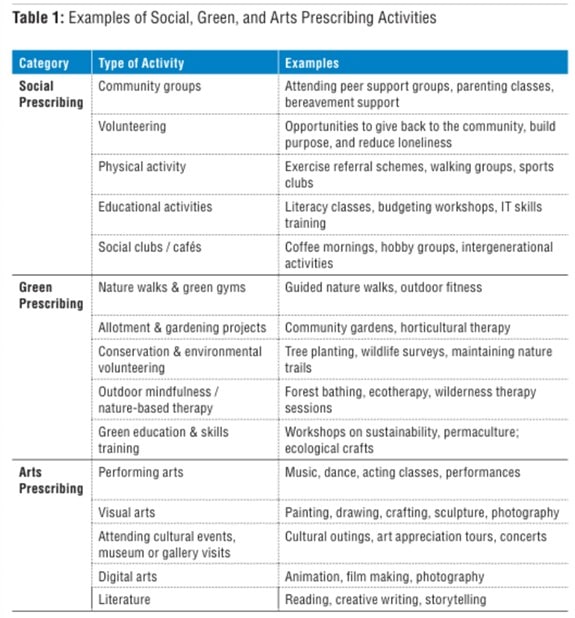
Nature-based social prescribing is an increasingly popular subset of social prescribing; an emerging concept that complements the medicalised approach that continues to dominate the current healthcare systems. As a form of prescription, it connects patients with community resources, such as NbTs, art-based activities, community groups, and sports clubs, as well as other activities listed in the table below.
Social prescribing is quickly gaining interest for its holistic approach to care, able to be tailored entirely to a person’s needs. By addressing the non-medical causes of illness (such as loneliness), preventing disease, and reducing inequalities, it has a tremendous potential to reduce healthcare costs. On a community level, social prescribing can strengthen social cohesion by promoting community networks and intergenerational interaction, building interpersonal trust, and fostering a sense of belonging.
In a world where our lives have become more and more detached from nature, I appreciate the opportunity to work on NbTs as a way to reinforce our connection to nature and its potential for our health, representing EuroHealthNet as a partner in RESONATE. This project aims to better understand the causal links between nature, health, and wellbeing, and whether and how NbTs can support building individual and community resilience.
One of RESONATE’s main outcomes will be a ‘How-to’ guide on implementing Nature-based Therapies across various settings and population groups, accounting for the potential social, environmental, economic and health equity impacts. The guide is to be published in 2027. Within the project, EuroHealthNet is looking at the potential health equity impacts, identifying factors that may contribute to NbT uptake. The findings will inform recommendations on how to implement NbTs in an equitable way, which will be part of the final ‘how-to’ guide.

PaRx: A nature prescription program across Canada
As part of our role in RESONATE, I had the opportunity to travel to Vancouver in April, where I learned all about PaRx, Canada’s nature prescription programme. The programme is run by the BC Parks Foundation, and I was warmly welcomed by Dr. Melissa Lem and her team. Besides being the Director of the PaRx programme, Dr Lem is a Canadian family physician, President of the Canadian Association of Physicians for the Environment, and a member of the International Expert Advisory Board (IEAB) of the RESONATE Project.
Within the RESONATE Project, EuroHealthNet studies prescribers' perceptions of factors influencing the uptake of Nature-based therapies across Europe. Seeing the success of PaRx across Canada, we welcomed the opportunity to extend our study to Canada to learn about the program, what makes it so successful, how Canadian prescribers use it and engage with it, and their perceptions of factors influencing NbTs uptake.
The PaRx program began in Vancouver, British Columbia, in 2020 and now has more than 13,000 prescribers registered across the country. The number of partnerships continues to grow consistently, making nature more accessible to patients. These partnerships include free entry to local botanical gardens or art exhibitions that bring nature indoors, an annual pass to access Canada's National Parks, and benefits for free km to drive and share vehicles such as e-cars, e-bikes, or e-scooters, to reach nature in other locations.
PaRx received support and endorsement from major health organisations in Canada, such as the Canadian Medical Association and the Canadian Nurses Association, and significant media attention, helping promote and increase the program's visibility.
Talking to prescribers
Prescribers are medical or social care professionals. Once they register as one within the PaRx programme, they receive a nature prescription file, customised with a provider code, allowing them to prescribe nature activities. These prescriptions can let patients spend time in nearby nature, such as a local park, but also enjoy outdoor experiences, in their local communities, for example, in a botanical garden, through the programme's partnerships.
While in Canada, I had the opportunity to interview general practitioners, nurses, social workers, mental health professionals, and occupational therapists, and understand how they use PaRx and nature on prescription. We spent time talking about their approach to and use of nature prescriptions and identifying the barriers and enablers to their uptake, some of which were common and others profession-specific.
The lessons from the interviews, paired with the results of our European study, will ultimately be used for a RESONATE’s guide for health and social care professionals on how to start prescribing NbTs and scale up their use, thereby improving individuals’ health and wellbeing through nature. The guide and the results of the Canadian and European studies are planned to be published by the end of 2026.
Reflections on the trip
If one thing, my visit to Vancouver shows that the variety of NbTs offers big opportunities for both patients and prescribers. Individuals can choose from the many kinds of NbTs, based on their interests, needs, and health conditions. Meanwhile, prescribers can personalise prescriptions based on these factors, making them more likely to truly benefit their patients.
But for NbTs to be used to their full potential, proper infrastructure and processes are needed. In Europe, there is much variety in approaches to Nature-based Therapies, and to social prescribing in general. The main differences relate to which professionals can become prescribers, how activities are funded and financed, and which populations are targeted. Such variability can inspire countries to integrate social prescribing into existing frameworks and strengthen community-based care in local contexts.
The route forward
Among these challenges is the difficulty of measuring and assessing the impact of social prescribing using existing evaluation methods, as well as the lack of standardised definitions. It can also be difficult to implement prescribing equitably and to secure adequate, sustainable funding. It should also be considered that, if too popular, social prescribing may put extra pressure on third-sector organisations offering the activities at a local level. More research is needed to understand how to, in practice, overcome these challenges. EuroHealthNet will help bridge this knowledge gap through its role in RESONATE and other projects, such as Social-Prescribing EU and Invest4Health.
The prescription of nature, art, and social activities has an unquestionable potential for health promotion, disease prevention or as a complementary form of care to medical treatment. And although it is gaining momentum, clearer frameworks, adequate funding and training are needed to integrate such an innovative health approach to standard care and routine practice in health and social care facilities.

Sofia Romagosa Vilarnau
Sofia joined EuroHealthNet in June 2023 as a Research Officer and supports the Research platform with the development of activities for the Horizon Europe funded projects FEAST and RESONATE.
Before joining EuroHealthNet, Sofia worked for more than three years in a European patient organisation on their activities related to internal and EU funded research projects as well as on matters related to membership. She holds a Master’s in Public Health from Karolinska Institutet and a Bachelor’s in Sociology from the University of Barcelona.